Buying a Home in Calgary & Area

Most of our business comes from referrals and repeat clients, more than 90% of it. Whether someone you trust sent you here or you found us on your own, here's exactly what buying with us looks like.

What happens after you call us

It starts with a phone conversation. Before anything else, we're listening: where you're at in the process, how much buying experience you have, what you're trying to accomplish.

Whether you're buying your first home or your fifth, the approach is the same: we're not there to sell you anything. The property and the neighbourhood do that on their own, or they don't. Our job is to be a trusted advisor, someone who helps you make an informed decision and protects your interests.

If you've bought before, we're not going to walk you through the basics. Instead we'll flag anything that's changed since your last purchase, new laws, new contract requirements, shifts in how offers get written. If you're moving to Calgary from another province, we'll walk you through what's different here. Alberta doesn't have a land transfer tax, for one. Terminology changes too, and it matters when you're trying to understand a contract.

If you're a first-time buyer, we go deeper. What closing costs actually look like. How buyer representation agreements work. What to expect at a home inspection, or when reviewing condo documents if you're looking at a condo. If you're looking at an older home, we'll tell you what to watch for based on the era it was built, so you know what you're getting into before you fall in love with a place.

From there, we might meet for coffee, meet at the office, or just pick a few properties and go look at them together while we talk through the process. The point of that first meeting is figuring out whether we're a good fit to work together.


Welcome!

Should I get pre-approved before I start looking at homes?

Yes, and there's a real difference between a pre-qualification and a full pre-approval.

A broker can give you a ballpark number based on a few questions in five minutes. That's a pre-qualification, and it isn't worth much when it comes time to compete for a house. A full pre-approval means your documentation is submitted up front. It gets you a better rate hold, fewer surprises, and a genuine advantage when you write an offer: a shorter condition period and more confidence from the seller that your financing will actually close.

It also means that once your offer is accepted, most of your paperwork is already sitting with your mortgage broker. During a condition period, that's one less thing to scramble for.

We work with a handful of mortgage brokers, mortgage specialists, and bank representatives we trust and recommend. What sets them apart isn't just rate. They take the time to understand your situation and explain why a particular mortgage or financing structure fits you, rather than handing everyone the same product. Every buyer's situation is different, and a good broker treats it that way.

Welcome!

How much down payment do I need to buy a home in Calgary?

In Canada, the minimum down payment is tied to the purchase price:

  • Homes priced at $500,000 or less: 5% of the purchase price
  • Homes priced between $500,000 and $1.5 million: 5% on the first $500,000, plus 10% on the portion above $500,000
  • Homes priced at $1.5 million or more: 20% of the purchase price

If your down payment is less than 20%, you'll need mortgage default insurance, which is added to your mortgage. On a $600,000 Calgary home, the minimum down payment works out to $35,000: 5% on the first $500,000, plus 10% on the remaining $100,000.

Two federal programs are worth knowing about if you're a first-time buyer. The First Home Savings Account lets you contribute $8,000 per year to a $40,000 lifetime maximum, tax-deductible going in and tax-free coming out. The RRSP Home Buyers' Plan lets you withdraw up to $60,000 from your RRSP tax-free toward a purchase, repaid over time. They can be used together.

If you're buying new construction, the First-Time Home Buyers' GST Rebate may apply. For agreements of purchase and sale signed on or after March 20, 2025, it eliminates the federal GST on a new home valued up to $1 million, phasing out between $1 million and $1.5 million. That's worth up to $50,000, and it's a real factor if you're weighing a new build against a resale home.

We'll walk through which of these apply to your situation before you start looking, so you know your actual number.

Welcome!

How do you find homes that aren't on the MLS?

Beyond setting up your search, a lot of what we do happens through relationships: conversations in our office, connections with other Calgary REALTORS®, and relationships with sales staff at new home builders, whose inventory often isn't posted on the MLS at all. That's how we sometimes know what's coming before it's public.

Your personalized search and automated listing alerts are still the fastest way to see new listings the moment they hit the market, and to track favourites and notes as you go. The difference is what happens after that. A lot of agents set up your search and leave it running. We stay in touch, check that your search parameters are still accurate as your priorities shift, and make sure nothing that matches what you're actually looking for slips through.

You can also search current Calgary listings directly on our site.

Calgary downtown skyline

How many homes should I look at before buying?

As many as it takes. Some buyers find the right home on the second showing. Others need to see fifteen before it clicks. There's no target number, and there shouldn't be.

Here's the test we use: if you leave a showing and catch yourself hoping nobody else puts in an offer before you get the chance, that's the signal to move. Until you feel that, keep looking. Once you feel it, don't sit on it.

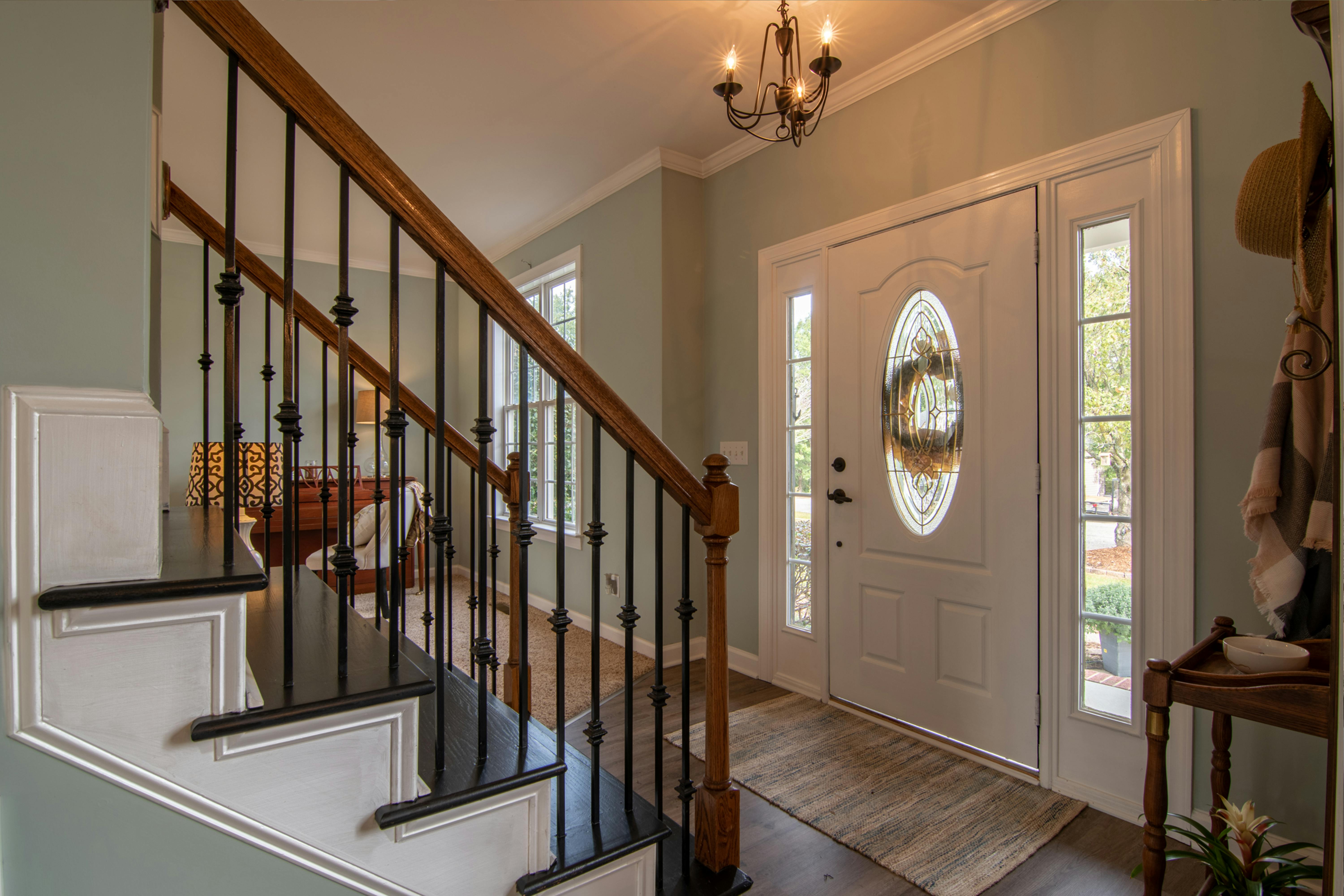
Interior staircase of a home for sale in Calgary

How much can I negotiate off the asking price?

It depends entirely on supply and demand at your specific price point. If there's a lot of competing inventory and few buyers, you may be able to offer well under asking. If inventory is tight and there are a lot of buyers looking, you may need to offer close to, or over, asking price just to compete.

A seller's asking price is arbitrary. What matters is fair market value, based on comparable sales and current market conditions, and that's what we help you establish before we talk strategy.

We've worked through hot Calgary markets with multiple competing offers and slower buyer's markets where our clients bought well under value. Both take experience and communication to navigate. We also listen closely to what we're hearing from the other side of a negotiation, because that's often where the real advantage comes from.

Comparable sales charts and calculator used to evaluate a Calgary offer

What conditions should I put in my offer?

Many offers include a financing condition, a home inspection condition, and if applicable, a condo document review. A well-qualified, pre-approved buyer can typically satisfy those conditions within a week, though the right timeline depends on your situation and your strategy. There's no one-size-fits-all approach.

Land Title document for an Alberta home purchase

What should I watch for in an older Calgary home?

Calgary's housing stock spans more than a century, and certain issues track closely to the era a home was built. These are the ones we look for:

  • Pre-1940: knob and tube wiring
  • 1950 to 1981: possible asbestos
  • Pre-1960: galvanized water lines
  • Pre-1970: cast iron or worse sewer lines
  • 1970s: aluminum wiring
  • 1970s: Federal Pioneer "Stab-Lok" electrical panels
  • Late 1980s to 2000: Poly-B water lines
  • Late 1980s to 2000: preserved wood foundations
  • 2000 to 2012: Kitec water lines, usually with in-floor heating or boiler systems

None of these automatically means don't buy. Several are manageable, and some have been remediated already by a previous owner. What matters is knowing what you're looking at before you write an offer, so the cost of dealing with it is part of your decision instead of a surprise afterward.

For a longer walkthrough, see what to check in an older Calgary home, by era.

Exterior of an older character home in Calgary

Do I need a home inspection?

Not all home inspectors are equal. We've worked with the good ones and the not-so-good ones over the years, and we're glad to point you toward the people we trust.

What separates a good inspector isn't just thoroughness, it's communication. You want someone who explains what they find in a way you actually understand, who doesn't downplay something that could become a real expense, and who also doesn't scare you off a home you love over a minor, easily fixed issue.

Buying a used home is a lot like buying a used car. A ten-year-old home is going to have some deficiencies. No home is perfect, and you should budget for minor repairs and improvements as a normal part of ownership. The purpose of the inspection is to educate you on the home and how to maintain it, not to give you leverage to renegotiate price. That said, if something significant turns up, a good inspector will catch it, and we'll walk you through your options.

One thing worth knowing before you make an offer: Poly-B plumbing and what it means for your offer.

Home inspection tools and checklist

What should I know before buying a condo in Calgary?

Buying into a condo corporation is a bit like buying into a small business. You're not just buying a unit, you're buying into how that corporation is run: its financial position, how accurately it budgets, and how proactive the board actually is.

A good condo document review looks at the financials, the reserve fund study, meeting minutes, and bylaws, and gives you a clear picture of what you're investing in. A healthy reserve fund and a board that plans ahead can be the difference between predictable condo fees and a special assessment you didn't see coming.

Condo document review companies vary in quality the same way inspectors do, and we'll point you to the ones we trust.

If the building was built between 2000 and 2007, ask about the plumbing specifically: Kitec plumbing in Calgary condos, and who pays to replace it.

Aerial view of a Calgary condo and townhouse complex

What are closing costs when buying a home in Alberta?

Legal fees and disbursements

Alberta doesn't have a land transfer tax, which is one of the meaningful cost advantages of buying here compared to Ontario or British Columbia. You do pay land titles registration fees, and they're much smaller.

As of October 2024, Alberta charges $50 plus $5 for every $5,000 of value, applied separately to the property transfer and to the mortgage registration. On a $600,000 home with a $480,000 mortgage, that works out to $650 to register the transfer and $530 to register the mortgage, or $1,180 in registration fees.

Your lawyer's bill has two parts, and it helps to know the difference.

Legal fees are what the lawyer charges for their own work: reviewing your contract and mortgage documents, searching title, preparing the transfer, handling the money, and registering everything correctly.

Disbursements are out-of-pocket costs your lawyer pays to third parties on your behalf and then bills back to you at cost. On an Alberta purchase, these typically include the land titles registration fees above, title and corporate searches, a tax certificate, courier charges, and software or technology fees.

Most Calgary firms quote a flat rate that bundles both together. On a $600,000 purchase with a mortgage, expect roughly $2,700 to $3,200 including GST, and that figure usually already includes the $1,180 in land titles registration fees rather than adding to it. Cash purchases cost less because there's no mortgage to register.

Title insurance is one item that commonly falls outside a flat rate. Ask what's included before you commit, and a good firm will tell you plainly.

Reviewing closing costs and budget with a view of downtown Calgary

What else to budget for

Beyond legal and registration costs, plan for your home inspection, condo document review if applicable, and adjustments reimbursing the seller for property taxes or condo fees they've already paid past your possession date. If your down payment is under 20%, mortgage default insurance is added to your mortgage rather than paid up front.

We break all of this down for your specific purchase early in the process, so the number you see on possession day is the number you were expecting.

Planning and budgeting for closing day costs beyond the purchase price

What happens on closing day?

At closing, you'll want a lawyer and paralegal who communicate clearly and lay out your closing costs and what to expect well before possession day. A good lawyer walks you through what you're signing and why, and takes the time to answer your questions so nothing catches you off guard. We work with law firms we trust and recommend without hesitation.

Family with keys and a moving truck on closing day

Why work with Kehler Healey Real Estate Co.

Colin and Brad are equal business partners, which means each has a real interest in taking care of the other's clients, not just their own. One practical benefit: between the two of them, they can almost always make themselves available to show a property on your schedule, not the other way around.

They listen closely and each bring twenty-plus years of experience to that conversation. They're not just people who open doors. They're advisors who protect your interests, whether you're a first-time buyer or a seasoned investor. They stay current on the laws, incentives, and programs that apply to your specific situation, and break down closing costs and fees early so there are no surprises later. If they don't know the answer to something, they say so, and go find the right answer from the people in their network rather than guess.

Colin Kehler and Brad Healey, partners at Kehler Healey Real Estate Co.

Let's meet, no obligation

However far along you are, whether you're just starting to think about it or ready to start touring homes this weekend, give us a call. No pressure, no obligation, just a conversation about where you're at and what you need.

You may also want to run the numbers on a mortgage, read through our buying tips, or if you have a home to sell first, find out what it's worth.

Staircase railing, a warm welcoming entryway
Data is supplied by Pillar 9™ MLS® System. Pillar 9™ is the owner of the copyright in its MLS®System. Data is deemed reliable but is not guaranteed accurate by Pillar 9™.
The trademarks MLS®, Multiple Listing Service® and the associated logos are owned by The Canadian Real Estate Association (CREA) and identify the quality of services provided by real estate professionals who are members of CREA. Used under license.